
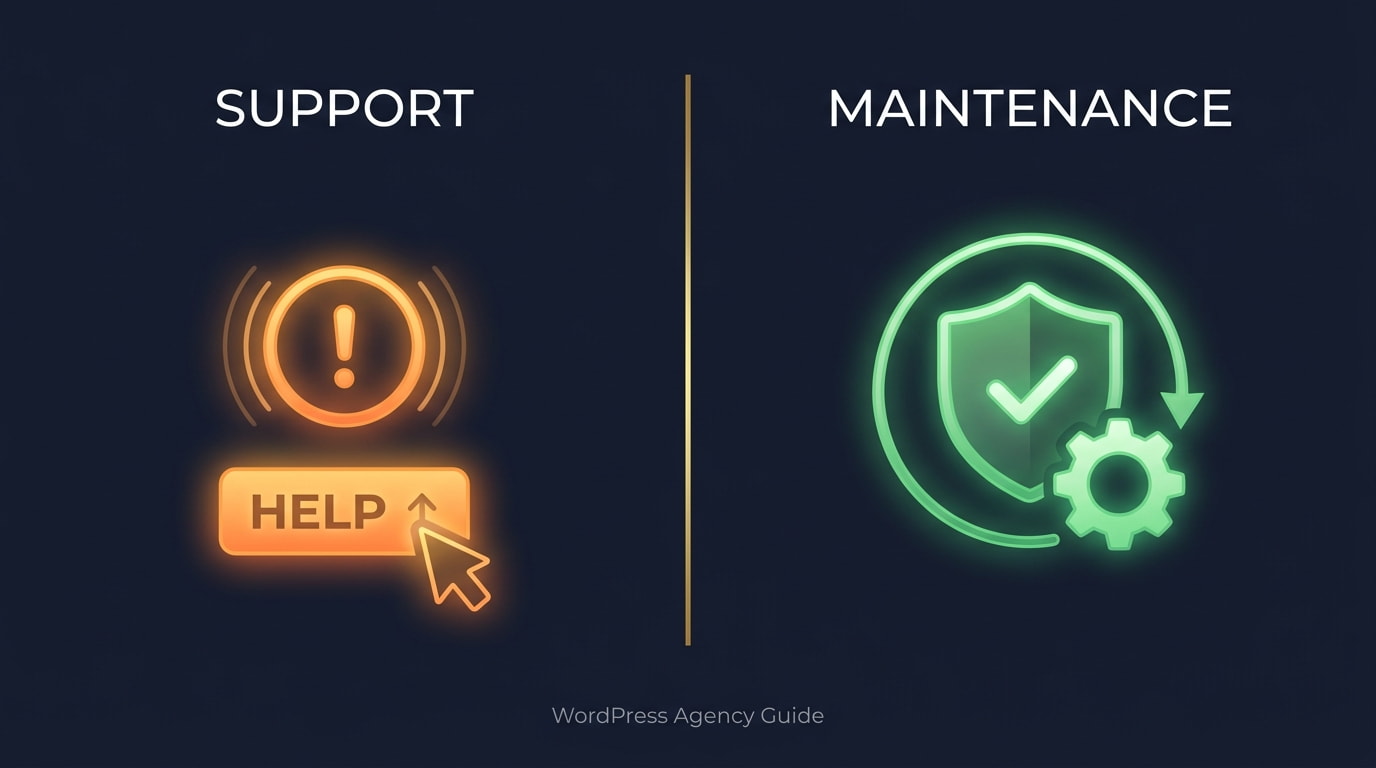
White label WordPress support and white label maintenance are not the same thing. Support is reactive. It kicks in when something breaks. Maintenance is proactive. It runs in the background every day to make sure things never break in the first place. If you are an agency trying to decide what to offer clients, or what to buy from a white label partner, understanding this difference will save you from client headaches and service gaps down the line.
Why This Question Comes Up
Most agencies start by offering one or the other without realizing they are leaving money on the table. A client who pays for support calls you when their site crashes. A client who pays for maintenance rarely calls you at all because their site rarely crashes. Both are valid services. But they serve different needs, attract different clients, and price very differently.
White label providers often bundle the two together, which adds to the confusion. Let us break them down clearly.
What Is White Label WordPress Support?
White label WordPress support is a reactive service. Something goes wrong, the client contacts your agency, and your white label team fixes it under your brand. The client never knows a third-party team handled the issue.
Support typically covers things like:
- A plugin conflict that breaks a page layout
- A theme error after a WordPress core update
- A checkout that stops working on a WooCommerce store
- A form that stops sending emails
- A client who accidentally deleted a page
- A site that goes down unexpectedly
Support is billed in one of two ways. Either as a block of hours the client can use each month, or as emergency tickets with an agreed response time. The key word with support is response. Something happened. You respond to it.
What Is White Label WordPress Maintenance?
White label WordPress maintenance is a proactive service. Nothing is broken. You are doing the work to make sure it stays that way. Your white label partner handles all of this silently, and you deliver the results to your client under your agency brand.
Maintenance typically covers things like:
- Weekly core, theme, and plugin updates tested in a staging environment
- Daily cloud backups with off-site storage
- 24/7 uptime monitoring with alerts if the site goes down
- Security scanning and malware checks
- Database cleanup and optimization
- Speed and Core Web Vitals checks
- Monthly branded reports delivered to the client
Notice that none of these require anything to be broken. You are preventing problems, not fixing them. That is the core difference.
Support vs. Maintenance: A Side-by-Side Comparison
When it happens: Support is triggered by a problem. Maintenance runs on a schedule regardless of problems.
What it involves: Support involves diagnosis and fixes. Maintenance involves updates, monitoring, and optimization.
How it is billed: Support is often hourly or ticket-based. Maintenance is a flat monthly fee per site.
Client experience: Support means the client contacts you when stressed. Maintenance means the client rarely contacts you because nothing is wrong.
Recurring revenue: Both can be recurring, but maintenance plans are far easier to sell as a monthly retainer.
Can You Have One Without the Other?
Technically yes, but it is not a good idea for either you or your clients.
If you sell support only, you will spend most of your time reacting to fires. Your clients will call more often. Your margins will be thinner because you are paying your white label partner for ad-hoc hours rather than a flat monthly rate. And the client will feel like their site is always having problems because they only hear from you when something goes wrong.
If you sell maintenance only, you protect the site and keep it healthy. But when something does break, such as a custom feature failing after a WordPress update, or a client accidentally wiping out a section of content, you need a plan for that too. Maintenance without some form of support coverage leaves a gap.
The smart move is to offer maintenance as your base recurring service and include a set of support hours on top. That way you are collecting predictable monthly revenue and your clients have a clear path to get help when they need it.
How White Label Makes This Work for Agencies
The reason most agencies do not offer proper WordPress maintenance or support is time. You are busy managing clients, selling new projects, and running a business. You do not have a dedicated WordPress technician refreshing security dashboards and testing plugin updates every week.
That is exactly what a white label partner does. You sell the service under your brand. You set the price. The white label team does all the work. You keep the margin. Your clients get consistent professional care and they think it is all coming from you.
For example, a white label maintenance plan might cost you around $60 per site per month from your provider. You resell it to your client for $150 to $200 per month. That is $90 to $140 in pure margin, per site, every month. Scale that to 20 or 30 clients and it becomes a serious revenue stream that requires almost no time from your team.
Which One Should You Lead With When Selling to Clients?
Lead with maintenance. Here is why.
Support is easy for a client to say no to because they are thinking about a problem that has not happened yet. Maintenance is easier to sell because it is tied to something they already care about, which is keeping their site fast, secure, and live. You are not selling them a safety net. You are selling them peace of mind and a monthly report that proves their investment is being looked after.
Once a client is on a maintenance plan, upselling support hours is simple. You can frame it as adding a dedicated response resource to their existing plan.
What to Look for in a White Label Partner That Offers Both
Not every white label provider handles both well. Some are good at scheduled maintenance tasks but slow on emergency support. Others promise fast response times but rush through maintenance work. Here is what to look for:
- Staging environment testing before any updates go live
- Clear response time SLAs for support tickets
- Daily backups with verified restoration capability
- Branded monthly reports that you can send directly to clients
- A strict no-contact policy with your clients
- Transparent pricing with no surprise fees for extra tasks
Final Thought
White label WordPress support and maintenance are complementary services, not interchangeable ones. Maintenance keeps sites healthy every day. Support fixes things when they go wrong. Together they give your clients comprehensive care and give your agency a reliable recurring revenue stream. If you are currently offering only one, now is a good time to add the other.


Comments are closed