
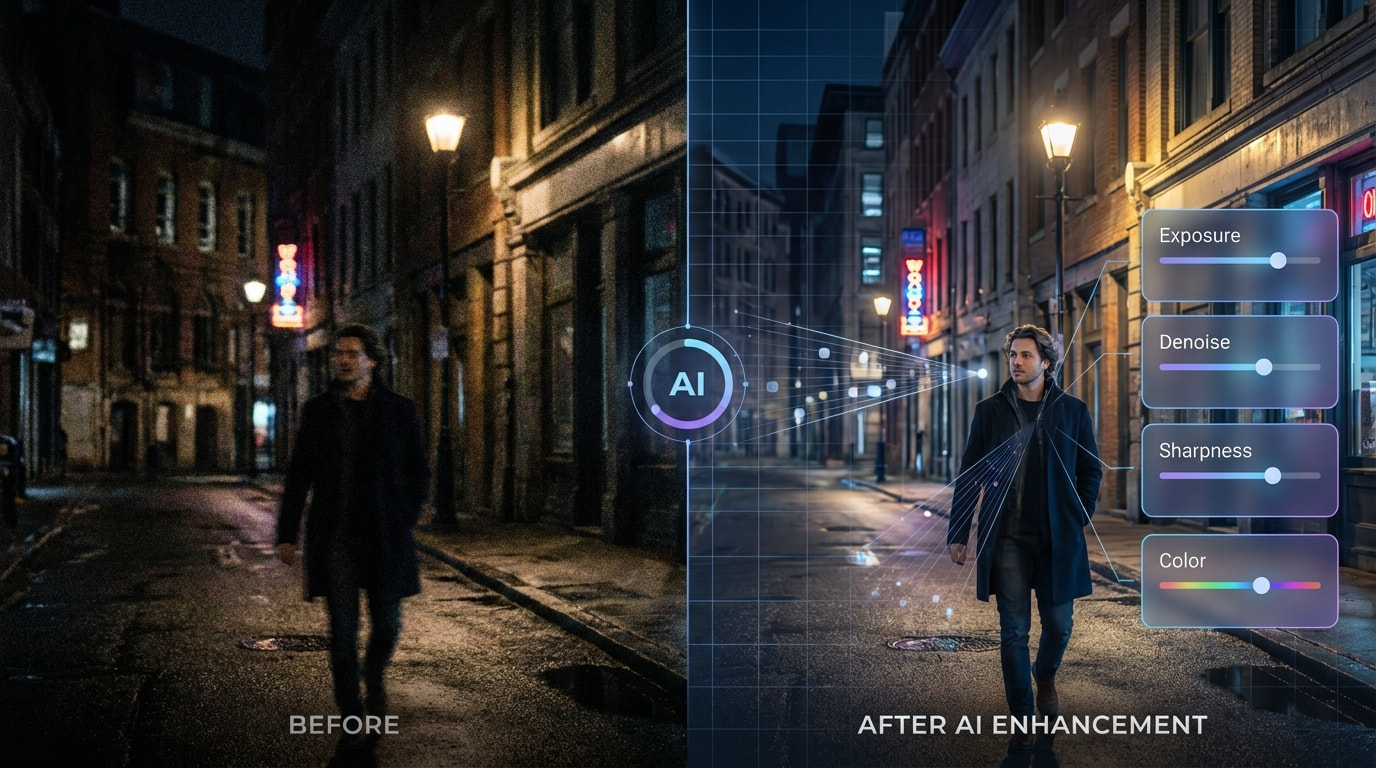
Low-light photography can feel magical. City lights glowing at night, candles flickering during dinner, or stars shining in a dark sky can create stunning scenes. But capturing those moments clearly is not always easy. Many photos taken in low light end up looking dark, grainy, or blurry.
This is where an AI image enhancer changes everything. Instead of letting your night photos go to waste, AI can now brighten, sharpen, and restore details automatically. In this guide, we will explore how AI image enhancement works, why it matters for low-light photography, and how modern tools make it simple for anyone to improve their photos in seconds.
Why Low-Light Photography Is So Challenging
Low-light conditions create problems for cameras, especially smartphones.
When there isn’t enough light, your camera tries to compensate by:
- Increasing ISO, which adds grain or noise
- Slowing down shutter speed, which causes blur
- Opening the aperture wider, which reduces depth of field
As a result, you may see:
- Grainy textures
- Faded colors
- Poor contrast
- Loss of small details
- Motion blur
Even professional photographers struggle with this. According to Digital photography principles, cameras depend on available light to record accurate data. When that light is missing, image quality drops.
What Is an AI Image Enhancer?
An AI image enhancer uses artificial intelligence to improve photo quality automatically. Instead of manually adjusting brightness, contrast, sharpness, and noise reduction one by one, AI analyzes the image and makes intelligent corrections.
It studies:
- Exposure levels
- Color balance
- Texture details
- Noise patterns
- Edge clarity
Then it enhances the photo in a balanced way without making it look fake or over-processed.
Unlike traditional editing tools, AI does not rely only on sliders. It understands patterns learned from millions of images and applies improvements that look natural.
How Invideo’s AI Image Enhancer Simplifies the Process
Invideo brings this power into a simple online tool. Instead of complicated software or editing knowledge, you can upload your image and improve it instantly.
The AI image enhancer on invideo is designed for speed and ease. You upload your photo, and the system automatically enhances brightness, sharpness, and clarity while reducing noise.
You do not need advanced editing skills. The tool handles the heavy work so you can focus on your creative vision.
This approach aligns with invideo’s philosophy of removing technical barriers and making powerful creative tools accessible to everyone.
How AI Image Enhancers Fix Low-Light Photos
Let’s break down exactly how AI improves dark or poorly lit images.
1. Smart Brightness Adjustment
One of the biggest problems in low-light photos is underexposure. AI detects dark areas and brightens them carefully without blowing out highlights. Instead of simply raising overall brightness, it adjusts shadows and midtones separately. This keeps the image balanced.
2. Noise Reduction Without Losing Detail
When ISO increases, digital noise appears. It looks like colored specks or grain across the photo.
AI image enhancement tools:
- Detect noise patterns
- Remove grain
- Preserve textures like skin, fabric, and surfaces
Traditional filters often blur everything. AI separates noise from real detail, so your image stays sharp.
3. Color Correction in Dark Scenes
Low light often causes dull or inaccurate colors. Skin tones may look gray, and city lights may appear washed out.
AI restores:
- Natural skin tones
- Warm highlights
- True-to-life color balance
It also improves white balance automatically, especially in mixed lighting environments like street lamps and neon signs.
4. Sharpness and Edge Enhancement
Blurry night photos are common due to slow shutter speeds. AI detects edges and enhances clarity.
It sharpens:
- Facial features
- Building outlines
- Light reflections
- Text in the background
This creates a crisp image without creating harsh outlines.
5. Shadow Recovery
Shadows often hide important details in low-light images. AI brightens shadow areas intelligently while keeping contrast natural.
This means:
- More visible textures
- Clearer backgrounds
- Better depth perception
The result feels realistic instead of artificially bright.
The Role of Artificial Intelligence in Image Processing
Modern AI enhancement is built on deep learning models, often linked to research in Artificial intelligence and Machine learning.
These systems are trained on large datasets that include:
- Night photography
- Portraits in dim rooms
- Indoor event photos
- Outdoor evening shots
By studying patterns in millions of examples, AI learns what a properly exposed and sharp image should look like. When you upload a dark photo, it compares and improves it based on learned knowledge.
This is why AI enhancement feels more natural compared to old editing methods.
Who Can Benefit from AI Image Enhancement?
Low-light enhancement is not only for professional photographers.
It helps:
Social Media Creators
Instagram and content creators often shoot at events, cafes, or night locations. AI helps make posts look polished instantly.
Small Business Owners
Restaurants, event planners, and local shops often take photos in dim environments. Enhanced images look more professional for marketing.
Travelers
Travel photography includes sunsets, city nights, and candlelit dinners. AI makes those memories clearer.
Students and Everyday Users
Anyone using a smartphone can improve their low-light photos without technical skills.
Step-by-Step: Enhancing a Low-Light Photo
Here’s how simple it can be:
- Upload your low-light image
- Let AI analyze exposure and noise
- Automatically adjust brightness and clarity
- Preview the improved version
- Download the enhanced image
In seconds, your dark and grainy photo becomes clearer and more vibrant.
AI Enhancement vs Traditional Editing
Let’s compare the difference:
| Traditional Editing | AI Image Enhancement |
| Manual sliders | Automatic analysis |
| Risk of over-editing | Balanced corrections |
| Requires skill | Beginner-friendly |
| Time-consuming | Instant results |
For low-light photography, AI reduces the need for complex editing software and saves time.
Real-World Examples of Low-Light Improvement
AI enhancement works especially well in:
- Night cityscapes
- Indoor events
- Candlelight dinners
- Concert photography
- Sunset and twilight scenes
Instead of deleting dark photos, you can now restore them easily.
The Future of Low-Light Photography
AI is not replacing photographers. It is empowering them.
With AI tools improving rapidly, low-light photography will become more accessible. Even beginners can capture evening moments confidently, knowing they can enhance the results afterward.
As AI continues to evolve, enhancements will become:
- More realistic
- More precise
- Faster
- More customizable
The gap between smartphone photography and professional-level quality keeps shrinking.
Final Thoughts
Low-light photography has always been challenging. Grain, blur, and dull colors can ruin beautiful moments. But today, an AI image enhancer can transform dark images into clear, vibrant photos within seconds.
Instead of struggling with complex editing tools, you can rely on smart technology to restore detail, improve lighting, and remove noise automatically.
The best part? You don’t need to be a professional photographer or editor. You just need the right tool.
And when technology removes friction from creativity, more stories get told, more memories get preserved, and more moments shine exactly the way they deserve to.


Comments are closed